|
| virtual double | lambda_Giant (const Star *s) |
| |
| virtual double | lambda_Cheb (const Star *s) |
| |
| virtual double | lambda_AGB (const Star *s) |
| |
| virtual double | lambda_pureHe (const Star *s) |
| |
| virtual double | lambda_Giant (_UNUSED double Mzams, _UNUSED double Z, _UNUSED double Radius, _UNUSED double Menv, _UNUSED double lambda_th) |
| |
| virtual double | lambda_Cheb (_UNUSED double Mzams, _UNUSED double Z, _UNUSED double Radius, _UNUSED double Menv, _UNUSED double lambda_th) |
| |
| virtual double | lambda_AGB (_UNUSED double Mzams, _UNUSED double Z, _UNUSED double Radius, _UNUSED double Menv, _UNUSED double lambda_th) |
| |
| virtual double | lambda_pureHe (_UNUSED double Mzams, _UNUSED double Z, _UNUSED double Radius, _UNUSED double Menv, _UNUSED double lambda_th) |
| |
| virtual coeff_status | set_coeff_Giant (double Mzams, double Z, double Radius) |
| |
| virtual coeff_status | set_coeff_Cheb (double Mzams, double Z, double Radius) |
| |
| virtual coeff_status | set_coeff_AGB (double Mzams, double Z, double Radius) |
| |
| std::vector< double > | fitting_equation (double x) |
| |
| int | reset () |
| |
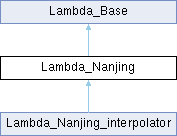
Basic Lambda model from the work of Xu&Li10 (https://iopscience.iop.org/article/10.1088/0004-637X/716/1/114) + its errata corrige (https://iopscience.iop.org/article/10.1088/0004-637X/722/2/1985). The implementation is taken directly from the COMPAS code https://github.com/TeamCOMPAS/COMPAS that is based on the STARTRACK implementation (see Dominik+12, https://ui.adsabs.harvard.edu/abs/2012ApJ...759...52D/abstract). Lambda is thus estimated as:
 y = a + b1*x + b2*x^2 + b3+*x^3 + b4*x^4 + b5*x^5

 where y is in general lambda (gravitational or considering also the thermal energy), sometime it is 1/lambda
 or sometime it is log lambda.
 x in general is the Radius, but sometime it is the mass of the envelope.
 The a and b coefficient are estimate for a given list of Mzams (1.,2.,3.,4.,5.,6.,7.,8.,9.,10.,12.,14.,16.,20.,50.,100.)
 and they are split in two broad metallicity bin (PopI and PopII), we define the PopI stars as the one with
 Z<0.085 that is half of the Zsun=0.017. They are also split in the three different evolutionary stages:

 - Stage 1 begins at the center H exhaustion and ends when the star starts to shrink (i.e., near center He ignition).
 - Stage 2 follows and ends when the star starts to expand again.
 - Stage 3  Stage 3 begins after that and continues until the end of the evolution.

 Following what has been done in COMPAS, we  identify the three stages with the SEVN phases:

 - Stage 1: TerminalMainSequence, Hshellburning
 - Stage 2: coreHeburning
 - Stage 3: TerminalcoreHeburning, Heshellburning

 NOTICE: We also use the lambda estimate for pureHE stars written in COMPAS in the Nanjing implementation.
 It has not published yet and  it is
     lambda = 0.3*R^(-0.8) with Radius Range between 0.25-120 Rsun, radii smaller or larger of that limit
     are set to the mimimum or maximum allowed value.
The lambda can be retrieved using the overload operator (Star *s) Using this class the lambda is estimated in a quantised way, i.e. for a Mzamsnot present in the table, the closed track with Mtrack>Mzams is used. If Mzams>100, Mtracks=100.

 1.9.5
1.9.5